
.png)
Marked for Christ
- Dec 21, 2025
- 8 min read
Marked for Christ: The Sacred Memory of Christian Tattooing from the Early Church to Medieval Pilgrims
There are moments in Christian history when faith does not rest only on parchment or prayer, but is carried on the body itself. Long before tattoos became fashion or rebellion, there were believers who marked their skin not to stand apart from Christ but to belong more deeply to Him. Their bodies became quiet testimonies, living manuscripts written in ink and pain, devotion and hope.
In the modern imagination, Christianity and tattooing are often placed at odds. Yet history tells a more complex and more human story. From the earliest days of the Church through the medieval pilgrimages to Jerusalem, Christians have inscribed their faith onto their flesh sometimes in defiance, sometimes in devotion, always in meaning.

The Early Church: Marked in a World of Persecution
The first Christians lived in a world that demanded visible loyalty to empire and gods not their own. To confess Christ openly could mean imprisonment, exile, or death. In such a context, the body was not neutral ground. It was contested territory.
Some early Christians bore marks forcibly, brands placed by Roman authorities identifying them as criminals or slaves. Others, however, chose marking as an act of spiritual allegiance. Early Church writers speak of believers being “sealed” with Christ, language that echoes both baptism and bodily marking. While explicit descriptions of tattoos are rare, understandably so in an era of persecution, there are references to Christians bearing the name of Christ or the sign of the cross upon their bodies.
For these believers, the body was not merely temporary. It was destined for resurrection. To mark it for Christ was not desecration, but consecration.
The theological tension was real. The Hebrew Scriptures warned against pagan cutting of the flesh, rituals associated with idolatry and death. Early Christians inherited this caution. But they also lived in a world where the body told a story whether one chose it or not. When a Christian chose to be marked voluntarily, it was not pagan mimicry but it was a quiet proclamation: I belong to Christ, even here, even now.
The Rise of Pilgrimage: Faith on the Road
As persecution waned and Christianity spread, faith began to move literally. Pilgrimage emerged as a physical expression of spiritual longing. To walk to Rome, Compostela, or Jerusalem was to pray with one’s feet, to suffer with intention, to draw nearer to God through exhaustion and risk.
Jerusalem held a special place in the Christian faith. It was not merely a city, it was the geography of salvation. To walk where Christ walked, to kneel where He suffered, to pray near the empty tomb was to collapse time itself.
And for some pilgrims, returning home was not enough. They wanted proof, not for others, but for themselves. A proof that they had been there. That their body had crossed the threshold of holiness.
By the medieval period, a remarkable tradition had taken root in Jerusalem: Christian tattooing. Pilgrims often after surviving months or years of dangerous travel would visit local Christian tattooists, frequently Coptic Christians, whose families preserved the practice for generations.
These were not casual marks.
Pilgrims tattooed crosses, Christograms (IHS), the Jerusalem Cross, images of the Crucifixion, saints, or dates commemorating their pilgrimage. Some added their names. Others chose symbols tied to vows or answered prayers.
Why tattoo?
Because parchment could burn. Medals could be lost. But the body marked and scarred would remember.
For many pilgrims, the tattoo was a seal. It said:
I have walked the holy road.
I have survived.
I have witnessed.
I belong to Christ, even unto death.
Some believed these marks would identify them as Christians if captured by hostile forces. Others believed the tattoo would serve as proof of pilgrimage in their home parish. And some, more quietly, believed that when they stood before God, their body itself would testify: I was there.
Who Were These Tattooed Christians?
They were not rebels.
They were farmers, monks, widows, knights, priests, merchants. They were men and women who had endured storms at sea, illness, robbery, and war. Many expected never to return home. The tattoo was not vanity, it was memorial.
A pilgrim might kneel while the needle worked, praying the Jesus Prayer with each puncture. Pain was part of the offering. Blood was part of the memory. In a world deeply acquainted with suffering, pain was not avoided it was sanctified.
This was not self-harm. It was embodied prayer.
Theology of the Marked Body
Christian theology has always wrestled with the body: fallen yet redeemed, fragile yet destined for glory. Medieval Christians understood something modern believers often forget, that the body participates in faith.
They fasted. They knelt. They walked hundreds of miles. They bore scars.
A tattoo, in this context, was no stranger than a calloused knee or a pilgrim’s blistered foot.
The Apostle Paul wrote, “I bear on my body the marks of Jesus.” For medieval pilgrims, this was not metaphor alone.
After the Middle Ages: Silence and Survival
As Christian attitudes shifted and Western theology grew more cautious, tattooing faded from common Christian practice, though it never disappeared entirely. Eastern Christians, particularly Copts in Egypt, continued to tattoo small crosses on wrists, marking identity and faith in hostile environments.
The tradition survived quietly, faithfully, handed down not through councils but through hands.
Jerusalem’s Razzouk Family Tattooed Christian Pilgrims for 700 Years
Along the ancient cobbles of Jerusalem’s St George Street, just inside the forbidding bulk of the Jaffa Gate, there is a family business that has been making its mark on visitors for 700 years.
The Razzouk family have been tattooing Christian pilgrims since the year 1300, and, incredibly, they are still going strong. At the oldest tattoo shop in the world.
For 700 years the Razzouk family has been tattooing marks of faith. Coptic Christians who settled in Jerusalem four generations ago, the family had learned the craft of tattooing in Egypt, where the devout wear similar inscriptions. Evidence of such tattoos dates back at least as far as the 8th century in Egypt and the 6th century in the Holy Land, where Procopius of Gaza wrote of tattooed Christians bearing designs of crosses and Christ’s name. Early tattoos self-identified indigenous Christians in the Middle East and Egypt. Later, as the faithful came to the Holy Land on pilgrimage, the practice expanded to offer these travelers permanent evidence of their devotion and peregrination.
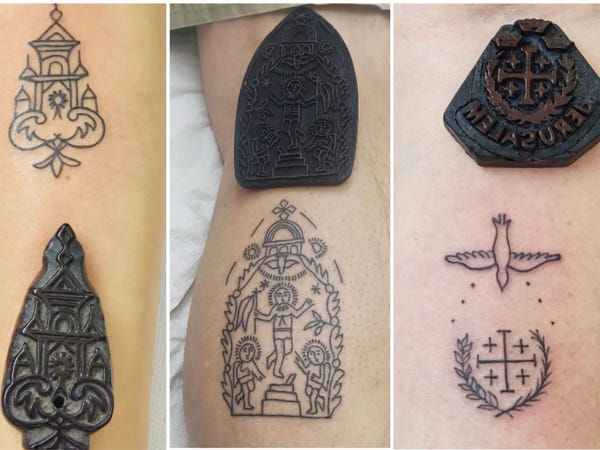
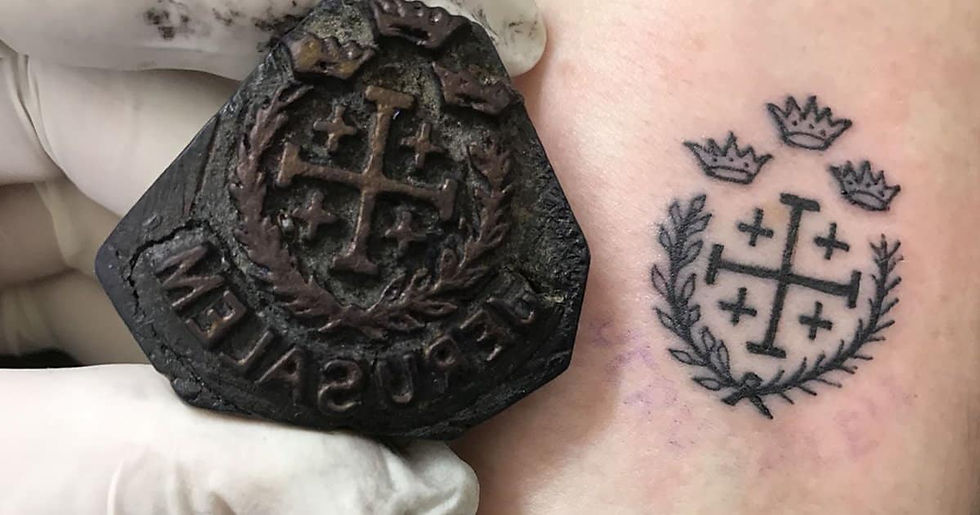


“Marked by Faith and Purpose: From Ancient Pilgrims to Modern Protector Knights”
In the dusty roads that led toward the Holy Sepulcher, countless Christian pilgrims of old sought sacred marks upon their skin, physical signs of a spiritual pilgrimage. These were not mere decorations, but indelible signatures of a life turned toward Christ and His suffering.
These tattoos served as permanent reminders that the believer had stood where the feet of the apostles once trod, that they had offered their pains and prayers on the Way of Sorrows, and that they carried home not just souvenirs, but tokens of transformation. Such marks were testimonies of devotion in an era when Christianity breathed not through holidays but through hardship and sacrifice.
This mingling of the physical and spiritual, the body bearing witness to the soul, was not accidental. It echoed the ancient truth laid down in scripture: “you are not your own; you were bought at a price” (1 Corinthians 6:19‑20). The flesh was more than skin, it was a sacred temple marked with the story of redemption.
And in medieval times, as knightly orders rose like bulwarks at the edge of Christendom, many a warrior carried crosses sewn into surcoats or emblazoned on shields. Some even bore tattoos of crosses, prayers, or saintly emblems on their arms, not just as protectors of land, but as humble defenders of faith and neighbor. While specific recorded instances are rare, art and written accounts, such as portraits of pilgrims with visible Jerusalem Cross tattoos, attest to this enduring tradition of marking devotion in the flesh.
The Echo of Templar's and the Dawn of Tribe 13
Centuries later, after the medieval orders such as the Knights Templar had faded from the world’s stage, the spirit of the protector, the warrior monk did not die. Tribe 13 arises in our modern age as a vivid echo of that ancient calling.
A brotherhood and sisterhood rooted in Christian faith, discipline, and service, Tribe 13 draws from the archetype of those who wielded the sword not for conquest, but for the sheltering of the weak, the care of the poor, and the vigilant defense of the innocent.
At the heart of our emblem stands a red cross shaped into a sword, a sign more than graphic art, more than a logo. It is a living credo, symbolizing the two intertwined pillars upon which this community stands:
the sword, representing readiness, training, and the willingness to face danger with courage;
the cross, embodying spiritual warfare, moral truth, and unwavering commitment to protect life and justice.
The number 13 is not arbitrary, but a remembrance of resilience honoring October 13, 1307, when the Knights Templar endured betrayal and persecution, yet whose values endured beyond that day. For Tribe 13, the number becomes a banner of perseverance, a reminder that to stand for truth and for others often means to stand in the face of adversity.

The Tattoo as Covenant: Bearing the Mark of the Protector
For Brothers and Sisters of Tribe 13 who choose to tattoo whether it be:
the Cross in Sword shape with the number 13;
the Protector symbol itself;
or the knight skull with a red cross
these marks are profound declarations woven into the flesh. Such ink is not a fashion statement, but a public and private witness:
“I walk the warrior monk path.”“With the sword in my hand, I have taken up my cross.”“I am called to protect, to defend the weak, the ill, and the poor.”
This is a sacred covenant written upon skin, a modern templar knight’s seal, echoing the pilgrims of old who bore simple crosses, and the medieval knights who carried faith into the crucible of battle. Not for glory, not for vanity, but for the humble service of others and the glory of God.
In an age that often celebrates comfort over courage, these marks stand as testimonies that the protector’s journey is both spiritual and corporeal, demanding discipline of body and soul, readiness of mind and compassion of heart. They proclaim that the wearer does not merely belong to a community, but serves a calling, a protector in truth, courage, and love.
Below are the Tribe 13 symbols that you can tattoo if you want to mark your path as a Protector.


Every tattoo you choose, the Cross in Sword shape with the number 13, the Protector emblem, the knight skull with red cross, becomes a permanent sacrament. It proclaims your commitment to the Templar Protector path: to stand in defense of those who cannot defend themselves, to bring aid to the ill and the poor, to wield strength with compassion, and courage with humility.
It reminds you daily that your body is a temple, your sword a tool of protection, and your life a vessel of faith.
As your Ministry Chaplain, I bless these marks. May they be a constant reminder of your sacred calling. May they guide your hand, steady your heart, and fortify your spirit. Walk this path boldly, knowing that you are not alone: the Templar's of the old, and the Brothers and Sisters of Tribe 13 stand with you. Carry your cross, wield your sword, protect the weak, honor the covenant for in this, the faith of centuries becomes the living testimony of today.
Go forth, marked in body and spirit, as Protector, Warrior and Servant of God.


This is a great read of history and I found it inspirational. I have followed Tribe 13 for quite some time and even completed a tactical combat knife course through the online school Udemy. I'm proud to be a part of this family
Thank you dear brother for these teachings 🌹🙏
great article brother! next month is my tattoo session scheduled 💪